

-
Main Causes of Poor Corrosion Resistance of Sintered NdFeB Magnets
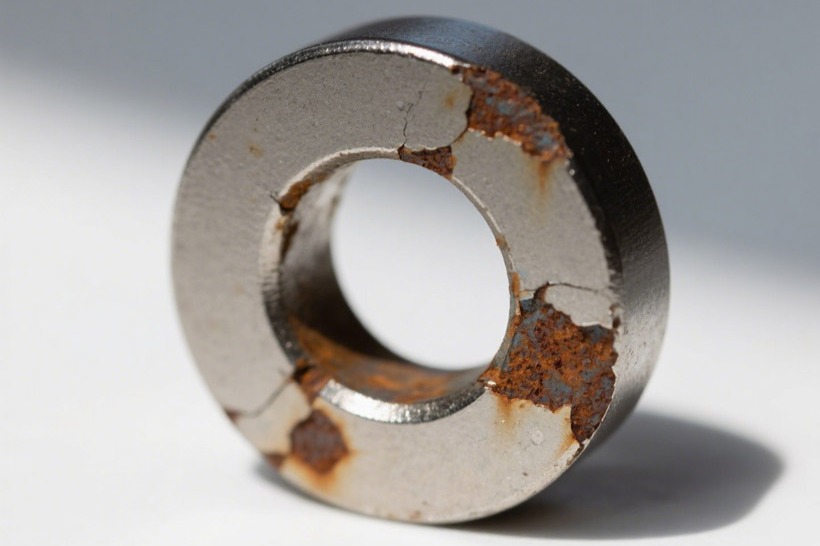
Sintered NdFeB permanent magnets exhibit excellent magnetic properties, yet they are highly susceptible to corrosion when exposed to ambient air or humid environments.
This drawback limits further expansion of their application scope. The main reasons for the poor corrosion resistance of sintered NdFeB permanent magnet materials are summarized as follows:
1.Fundamental Cause: Neodymium in sintered NdFeB possesses extremely high chemical activity, with a standard electrode potential of E0(Nd3+/Nd)=−2.431V. The material features a multiphase microstructure, among which the Nd-rich grain boundary phase shows the highest chemical activity. A significant electrochemical potential difference exists between different phases inside the magnet.In electrochemical corrosive environments, electrochemical corrosion readily occurs. The Nd-rich grain boundary phase acts as the anode to bear most corrosion current, while the main phase Nd2Fe14B serves as the cathode with low current load. This forms a typical corrosion characteristic of small anode vs. large cathode, accelerating the corrosion of grain boundary phases and eventually leading to structural failure of the entire magnet.
2.Inherent Structural Defects: Sintered NdFeB fabricated via powder metallurgy has low density and high internal porosity. No dense protective oxide film can form on its surface. Once oxidation initiates, internal pores act as rapid diffusion channels for oxygen and other corrosive media, triggering chain oxidation reactions inside the magnet and aggravating overall corrosion deterioration.
3.Harmful Impurities: Impurities such as H, O, N, S, Si, C, Cl and chlorides may be introduced into the magnet during production due to process conditions, equipment and manual factors. Among these, oxygen, chlorine and chlorides are the most detrimental to corrosion resistance.
4.Effect of Alloying Additives: Some alloying elements added to NdFeB can also impair corrosion resistance. Common additives like cobalt and copper improve magnetic performance and thermal stability, yet they may exert adverse impacts on the material’s anti-corrosion properties.
-


